























A multi-directional truck looks impressive in a brochure. What matters is how it handles your loads, your aisles, and your rack height. A demo day is where you find out. Used well, it replaces assumptions with measurements and gives you evidence to justify the purchase. Used badly, it becomes a quick drive around the yard. This guide explains how to prepare, what to test, and how to score the result, so your team leaves with answers, not impressions. It also lists the questions to ask your Combilift dealer before you raise a purchase order.
Why a Demo Beats a Spec Sheet
Combilift’s multi-directional trucks can move forward, backwards, sideways and diagonally, and the company says its trucks combine counterbalance, sideloader and narrow-aisle capability in one machine. That flexibility is the selling point, and it is also hard to judge on paper. Combilift recommends a no-obligation on-site demo to assess your layout and typical loads.
Before the Day: Write a Test Brief
Send your Combilift dealer a short brief at least a few days ahead, so the right truck arrives. Include:
- Your loads: Longest, heaviest and most awkward items, with weights and dimensions.
- Your narrowest aisle and tightest doorway: Measure them and bring the figures.
- Rack heights and beam clearances: Note the highest put-away you need.
- Surfaces: Concrete, ramps, compacted ground or uneven yard areas.
- Operators: Who will drive, and how much forklift experience they have.
- Power preference: Combilift says electric models suit indoor use, while diesel and LPG models suit outdoor and mixed use.
Choose Which Truck to Demo
Ask for the model that matches your heaviest regular load, not your average one. Capacities below come from Combilift’s published model pages.
| Model | Capacity | Power | Typical fit |
| Combi-CB | 2,500 to 3,000 kg | Diesel, LPG | Long loads, mixed indoor and outdoor use |
| Combi-CBe | 2,500 to 3,000 kg | Electric | Indoor operation |
| Combi-CB4 | 4,000 kg | Diesel, LPG | Heavier long loads |
| C-Series | 2,500 to 25,000 kg | Diesel, LPG or electric, by model | Wide capacity range |
| Combi-MR | 2,500 to 4,000 kg | Electric | Stand-on reach operation |
Our Combilift range in Bahrain also lists the Combi-WR walkie reach-stacker, which Kanoo’s page states can work in a very narrow aisle down to 2.1 m. Confirm the exact specification for any model with the manufacturer before you rely on it.
The Demo Day Test Routine
Run the same sequence for every truck you compare, and time each step. Use the same operators each time so results compare fairly, and film the runs so the wider team can review them later.
- Walk-around. Check the data plate for capacity and load centre, then check the forks, mast, tyres, and hydraulics.
- Familiarisation. Let each operator practise the steering modes in an open area for ten minutes.
- Narrow aisle run. Drive the tightest aisle with a real load, and note how much clearance remains.
- Long load sideways. Carry your longest item through doorways and between obstacles in sideways mode.
- Rack put-away. Place loads at your maximum height and at ground level, repeating several times.
- Surface test. Drive over ramps, joints, and outdoor ground. Combilift says dynamic traction control adjusts wheel traction to conditions, so check how it feels in practice.
- Truck loading. Load and unload a delivery vehicle the way you do on a normal day.
- Duty cycle. For an electric truck, check battery use over a realistic work period.
The Demo Scorecard
Score each test that day, and agree on the pass criteria before you start.
| Test | What to measure | Your pass mark |
| Aisle width | Clearance to racking with a load | Set by your layout |
| Long loads | Control, stability, doorway clearance | No contact, no load shift |
| Put-away | Time per pallet or load, accuracy | Match or beat current method |
| Surfaces | Grip, ride and load stability | Stable on every surface used |
| Operator feedback | Visibility, comfort, controls | Majority comfortable after practice |
| Power | Run time or fuel use per shift | Covers your shift pattern |
Combilift says its warehouse planning service can identify layout changes that increase storage capacity by up to 50%. Treat that as a vendor claim, and test it against your own racking before it enters a business case.
What to Check on the Machine Itself
A demo is also a quick way to assess build quality and usability.
- Visibility: Can the operator see the load, the forks, and the aisle ahead?
- Cab and controls: Is the seat adjustable, and are controls easy to reach?
- Noise and vibration: Note how the operator feels after an hour.
- Hydraulics: Look for smooth lift and tilt, and no visible leaks.
- Attachments: Ask whether the truck can take the forks or attachments you need.
- Safety: ISO 3691-1 sets safety requirements and verification for self-propelled industrial trucks, so ask how the truck meets your site’s safety standards.
Electric or Engine: Test the Power You Will Use
Combilift describes its electric models as zero-emission, which matters in enclosed spaces, and says they help reduce noise and fuel costs. Electric trucks suit indoor work, while diesel and LPG models are listed for outdoor and mixed use. If your site does both, test both. For electric models, ask how long charging takes and where the charger will sit. For diesel and LPG, ask about fuel storage and servicing intervals. Test the power type that matches your busiest shift, not your quietest.
Questions to Ask Before You Buy
Product choice is only half the decision. The Combilift dealer you buy from will support the truck for years.
- Are you an authorised distributor for this model? Kanoo Machinery says it is an authorised Combilift dealer in Bahrain.
- What is the delivery lead time for the model I tested?
- Which spare parts are held locally?
- What service and maintenance support do you provide, and how is it scheduled?
- Is operator training included?
- Do you offer used or rental options if my needs change?
Common Demo Day Mistakes
Most poor decisions after a demo trace back to a handful of avoidable errors:
- Testing with empty forks. A truck that feels agile unloaded can behave very differently when loaded to its heaviest capacity.
- Using only the best operator. Let average operators drive too, because they reflect everyday use.
- Skipping the awkward spots. The tight corner, the sloped ramp, and the highest rack level expose limits.
- Ignoring the support conversation. Ask about parts, service, and training on the same day, while the dealer team is on site.
- Not recording results. Without notes and timings, opinions fade within a week.
After the Demo: Compare Results
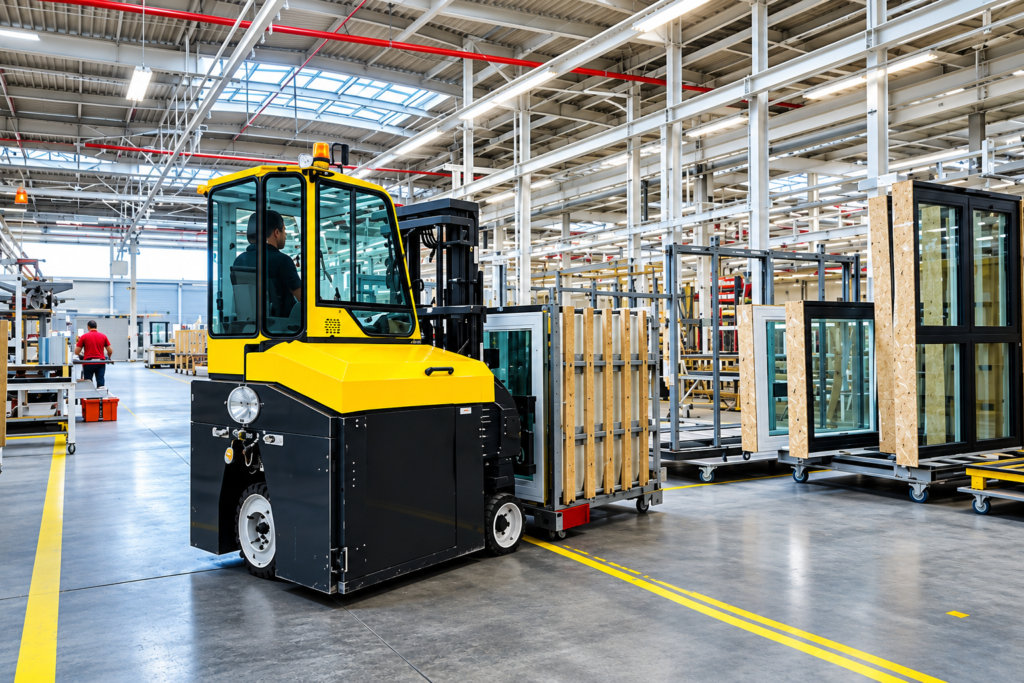
Review the scorecard with operators, warehouse managers, and finance. Look at three things:
- Performance: Did the truck meet your pass marks on every test?
- Fit: Did it work in your narrowest aisle and with your longest load?
- Support: Are parts, service, and training available locally?
If two trucks score similarly, support often decides, so ask your Combilift dealer to put its service and parts commitments in writing.
Conclusion
A good demo is a controlled test, not a drive around the yard. Bring your real loads, measure your aisles, score every step, and judge the machine and the support behind it. That approach turns a multi-directional truck from an interesting idea into a decision you can defend. Kanoo Machinery is an authorised Combilift dealer in Bahrain, offering parts and service support for the equipment. Contact the Kanoo Machinery team to discuss your loads and layout, and ask how to arrange a demonstration with a trusted Combilift dealer.
Frequently Asked Questions
What should I bring to a Combilift demo?
Bring your longest and heaviest loads, aisle and door measurements, rack heights, and the operators who will drive. A written test brief helps the demo truck match your needs.
How long should a demo take?
Allow enough time to run every test with several operators, including put-away at height and truck loading. A rushed demo gives poor evidence.
Is electric or diesel better for a multi-directional truck?
It depends on where you work. Combilift lists electric models for indoor use and diesel or LPG models for outdoor and mixed use.
Who can I speak to in Bahrain about a Combilift demo?
Contact Kanoo Machinery, which describes itself as an authorised Combilift dealer in Bahrain, to arrange a demonstration.