






















What a Traditional Forklift Actually Does Well?
Traditional counterbalanced forklifts have been the warehouse default for good reason. They’re simple to operate, widely understood by the workforce, and effective for handling standard palletised loads in facilities with wide aisles and consistent load sizes.They move fast. Training new operators takes less time. Maintenance is well understood across most service providers. For facilities that deal primarily with uniformly sized pallets, relatively open aisle configurations, and loads that don’t exceed standard dimensions, a conventional forklift handles daily operations without complication.
The limitations surface when the work changes. Long loads, narrow aisles, and tight floor space are where traditional forklifts begin to create operational friction that compounds over time.
Where Traditional Forklifts Run Into Trouble?
The fundamental design constraint of a conventional counterbalanced forklift is that it moves forward and backward. To transport a long load of steel beams, timber, pipes, and aluminium sections, the machine has to carry it lengthwise, which means the load extends well beyond the machine’s width. Getting that through a narrow aisle, around a corner, or through a doorway requires significantly more space than the machine’s own footprint suggests.In practical terms, this forces wider aisles, which reduces storage density. It also creates safety exposure when loads are carried sideways, a practice sometimes called “airplaning,” which increases the risk of product damage and operator incidents. Facilities handling long loads with conventional forklifts often compensate with staging areas, additional handling steps, and multiple machine types operating together. Each of those workarounds adds cost and time.
What Combilift Was Built to Solve?
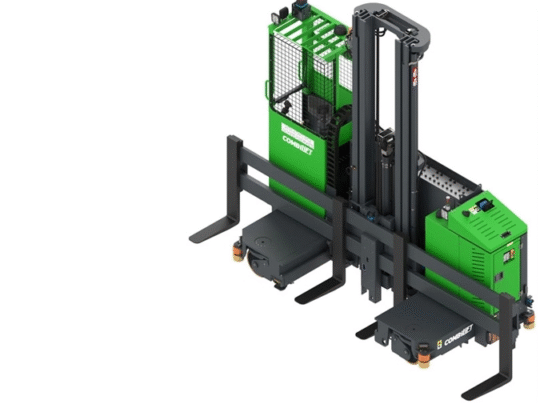
Combilift was specifically designed to address the problem of long-load handling in confined spaces. The core engineering difference is multidirectional travel: Combilift machines can move forward, backward, and sideways by reorienting their wheels, without turning the entire machine. This allows long loads to be carried at a low, stable level and transported laterally through narrow aisles without requiring the wide turning radius that conventional forklifts demand.The Core Technical Differences
| Feature | Traditional Forklift | Combilift |
| Travel direction | Forward and backward only | Forward, backward, and sideways |
| Long load handling | Requires wide aisles or sideways carry | Carries loads laterally at a low level |
| Aisle width requirement | Typically 3.5m+ for counterbalanced | From 1.6m for Aisle Master VNA models |
| Machine versatility | One function per machine | Combines counterbalance, sideloader, and VNA |
| Indoor/outdoor capability | Mostly indoor | Both indoor and outdoor surfaces |
| Space utilisation | Lower-density layouts | Storage capacity increases up to 50% |
Combilift Maintenance: What the Machine Requires?
A Combilift unit is a more complex machine than a conventional forklift, and Combilift maintenance reflects that. The multidirectional steering system, hydraulic engineering, and wheel positioning mechanisms require specific attention on a structured schedule, not just when something stops working. Proper Combilift maintenance also covers:- Grease all points on the grease chart at scheduled intervals
- Checking all electrical connections and terminals
- Inspecting nuts, bolts, brakes, and steering at each service interval
- Monitoring tyre condition, which directly affects stability in narrow aisles
- Checking hydraulic hoses and connectors for wear or leakage
For facilities in Bahrain, unplanned downtime carries real operational costs. A structured Combilift maintenance programme following manufacturer-specified intervals and using genuine parts keeps the machine performing at the output levels it was specified for.
Combilift Maintenance vs. Traditional Forklift Maintenance
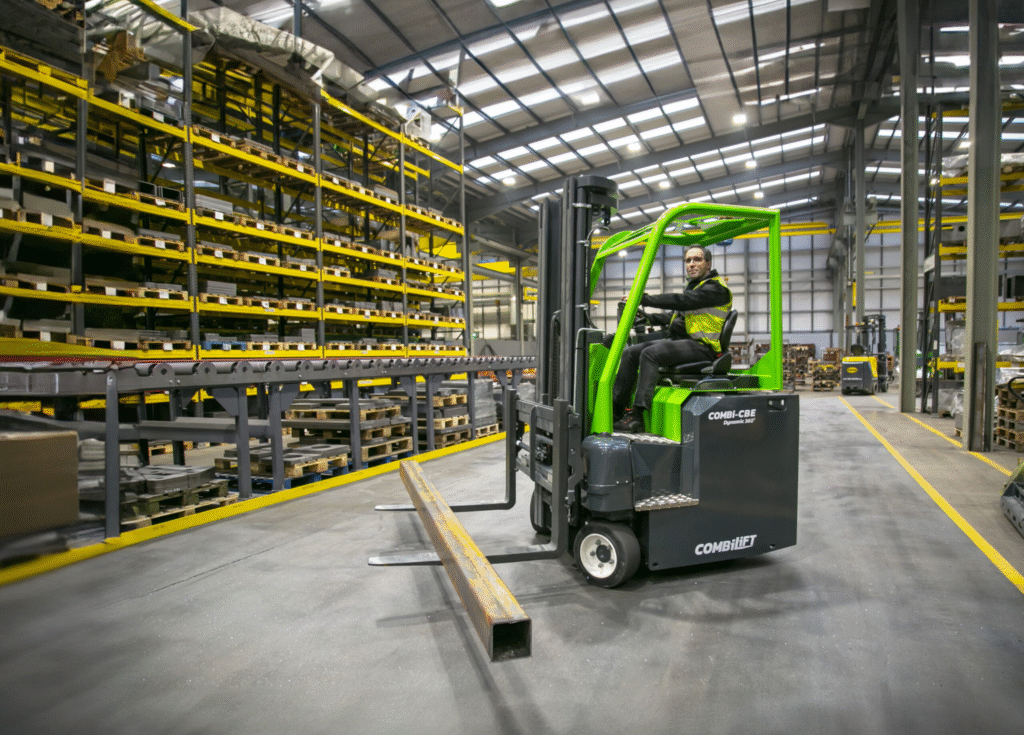
Traditional forklifts have a simpler mechanical structure, which generally means lower service complexity for each unit. Combilift maintenance involves more components; the multidirectional steering geometry, additional hydraulic circuits for lateral movement, and the wheel orientation system all need periodic attention beyond what a standard forklift requires.
Which One Does Your Operation Actually Need?
Three questions determine the answer:| Question | Choose Traditional Forklift | Choose Combilift |
| What loads are you handling? | Standard palletised goods, uniform sizes | Long loads — steel, timber, pipes, oversized components |
| What does your floor space look like? | Wide aisles, no storage density pressure | Tight aisles, storage capacity is a constraint |
| What does your environment involve? | Controlled indoor facility only | Mixed indoor a |
Final Take
Traditional forklifts remain a practical, cost-effective solution for facilities that handle standard loads in standard conditions. Combilift machines solve a different, more specific problem: long-load handling, narrow-aisle operation, and floor-space recovery in warehouses where conventional equipment creates bottlenecks.The decision between the two isn’t about which brand is better. It’s about matching the machine to the actual work. Kanoo Machinery is an authorised Combilift dealer in Bahrain. We supply the full Combilift range and our team provides 24/7 qualified service support. Visit our website or talk to our team about your requirements at 800 01125
FAQs
What is the main difference between a Combilift and a traditional forklift?A traditional forklift travels only forward and backward. A Combilift can also travel sideways, allowing long loads to be transported laterally in narrow aisles without the wide turning radius a conventional machine requires.
Is Combilift only useful for long loads?No. Combilift’s multidirectional range handles both palletised standard loads and long materials. The advantage is that a single machine covers both applications, reducing the need for multiple specialised units.
What does Combilift maintenance typically involve?Combilift maintenance covers mast chain lubrication and inspection every 250 hours, hydraulic oil changes at 2,000-hour intervals, steering and brake checks, electrical connection inspections, tyre monitoring, and use of genuine Combilift components per manufacturer specifications.
How much space can a Combilift save in a warehouse?Combilift’s Aisle Master VNA trucks operate in aisles as narrow as 1.6 metres and can increase warehouse storage capacity by up to 50% by reducing the floor area used for aisles.
Can Combilift operate outdoors?Yes. Combilift machines are designed to work on both indoor and outdoor surfaces, making them suitable for facilities where equipment moves between internal warehouse areas and external yards.