




















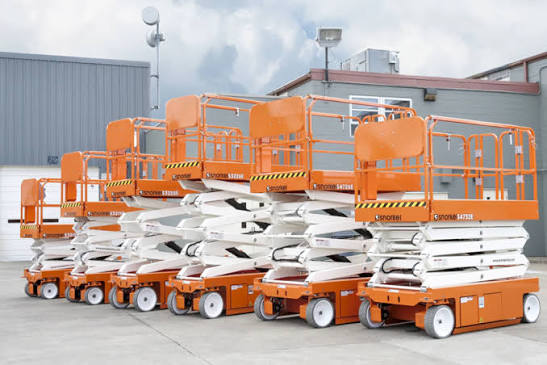

An aerial work platform that goes down mid-project in Bahrain’s construction or industrial sector doesn’t fail at a convenient time. It fails when the access it provides is needed, when a team is on-site, when a deadline is attached to the work it’s enabling. Reactive maintenance waiting for something to stop working before addressing it is the model that creates that scenario.
Predictive maintenance is a departure from the react-and-repair pattern: utilizing real-time machine data, condition monitoring, and pattern recognition to identify impending failures and scheduling repairs at a more appropriate time than during a crisis.
For Bahrain facilities and contractors running aerial work platforms across construction, industrial maintenance, and infrastructure projects, the gap between reactive and predictive maintenance is measured in operating hours lost, emergency callout costs, and project delays that compound down the schedule.
What Predictive Maintenance Actually Means for Aerial Work Platforms
Predictive maintenance is the stage beyond scheduled preventive maintenance. Preventive maintenance runs on time or hour intervals replace this filter every 250 hours, inspect this system every 500 hours. It reduces failures compared to reactive maintenance, but it doesn’t tell you whether a specific component is actually degrading faster than the schedule assumes.
Predictive maintenance uses real machine data sensor readings, operating patterns, fault codes, hydraulic pressure trends to identify when a specific component on a specific machine is approaching failure, regardless of where it sits on the schedule. A hydraulic pump that’s showing increasing current draw without a corresponding increase in output pressure is degrading. A boom cylinder that’s losing position under load between movements is developing internal bypass. A battery that’s declining faster than expected across charge cycles is approaching replacement.
Snorkel OnSite: How the Technology Works on Snorkel Aerial Work Platforms
Snorkel’s telematics solution Snorkel OnSite, powered by Trackunit, is available on most current Snorkel mobile elevating work platforms and telehandlers, many of which are now telematics-ready, featuring a compatible connection for the telematics module.
Factory-installed sensors monitor machine health and operation. Remotely diagnose issues with precise technical data and analytics for proper scheduling of equipment repairs and maintenance.
Data is transmitted every 15 minutes for accurate analytics that allow you to maximize machine use, improve service planning and ROI. Manage billing and reduce service costs with data on true working time of elevation, driving, loading, idling, total run times, etc.
Real-time SMS alerts and email notifications are generated on each machine’s health, hours, and location. When a sensor reading crosses a defined threshold, hydraulic pressure goes outside spec, or battery voltage trends low, an abnormal fault code sequence triggers an alert that goes to the fleet manager and the service team simultaneously. The response is scheduled before the machine fails, not after.
Mixed fleet capability allows you to integrate data to easily find and manage all your telematics-enabled equipment from a single dashboard. For operations running Snorkel aerial work platforms alongside other equipment types, all machine data feeds into one interface rather than requiring separate systems for each brand.
What the Data Actually Monitors
The Snorkel OnSite system tracks the parameters that matter for maintenance decision-making on aerial work platforms:
| Data Point | What It Reveals |
| Hours of elevation | Actual productive use vs. total runtime |
| Driving hours | Ground-level travel load on drive components |
| Idling time | Fuel or energy consumption without productive output |
| Fault codes in sequence | Intermittent faults that precede component failure |
| Load cycles | Accumulated structural and hydraulic load |
| Location | Machine position for fleet management and utilisation |
The distinction between elevation hours and total runtime matters specifically for hydraulic component wear. An aerial work platform that spends most of its time driving between positions puts different wear on the hydraulic circuit than one that spends most hours elevating and holding position under load. The maintenance schedule should reflect the actual usage pattern, not just the total hours.
What Changes Operationally When Predictive Maintenance Is Running
- Maintenance visits become planned, not reactive. Instead of an emergency callout when a machine stops, the service visit is scheduled during a planned downtime window end of shift, a quiet period between project phases and the machine is back in service before the next working period.
- Parts are ordered before they’re needed. When sensor data identifies a component approaching end of life, the part can be ordered and on-site before the service visit happens. The visit starts with the part in hand, not with a fault diagnosis that ends with ordering and waiting.
- Fleet utilisation data improves deployment decisions. Knowing which machines accumulate elevation hours fastest, which sit idle, and which are frequently driven without productive lifting allows fleet managers to redistribute aerial work platforms across sites and projects more efficiently and identify underutilised machines that could be redeployed or returned.
- Operator behaviour data supports training decisions. RFID keypad options on Snorkel OnSite allow access control and operator identification. If one operator consistently generates more fault codes or impact events than the fleet average, that data supports a targeted training conversation rather than a general retraining exercise.
Snorkel’s Support Infrastructure Behind the Data
Telematics data is only useful if maintenance responds quickly when needed. Snorkel’s support infrastructure backs up the predictive capability: over 95% fill rate within 24 hours on all fast-moving parts, and 98% of parts shipped within one week of order receipt, with millions of dollars in replacement parts held at each Snorkel factory location.
Final Take
Predictive maintenance on aerial work platforms doesn’t eliminate all unplanned downtime but it changes its frequency and severity significantly. Sensor-driven condition monitoring, 15-minute data transmission intervals, and real-time alerting shift the maintenance model from reacting to failures to scheduling interventions ahead of them. For Bahrain operations where aerial work platforms are central to daily construction, maintenance, and infrastructure work, Snorkel OnSite combined with Kanoo Machinery’s local service infrastructure makes that shift practical rather than theoretical. Kanoo Machinery provides the local service layer mobile service vans for on-site servicing. The gap between a maintenance alert and a resolved issue is as short as the operation requires. Visit the website or contact our team at 800 01125.
FAQs
What is Snorkel OnSite and how does it support predictive maintenance?
Snorkel OnSite is a telematics solution powered by Trackunit, available on most current Snorkel mobile elevating work platforms. It transmits machine health data every 15 minutes, monitors factory-installed sensors, and sends real-time SMS and email alerts when parameters exceed defined thresholds, enabling maintenance to be scheduled before failure occurs.
What data does Snorkel OnSite transmit?
Hours of elevation, driving hours, idling time, fault codes, load cycles, battery status, and machine location. The data feeds into a Trackunit dashboard or integrates via API into existing fleet management systems.
Can Snorkel OnSite be added to existing machines?
Yes. Snorkel OnSite is available for field installation by an authorised Snorkel distributor or service centre on telematics-ready Snorkel machines, as well as factory installation on new units.
Does Kanoo Machinery provide Snorkel OnSite installation in Bahrain?
Yes. As the exclusive Snorkel distributor in Bahrain, Kanoo Machinery provides factory-install ordering and field-installation support for Snorkel OnSite across the Snorkel aerial work platform range.