




















Not long ago, Nitrogen supply was something most facilities barely thought about. Cylinders showed up, bulk tanks got filled, and the process continued on autopilot. It worked well enough, and nobody pushed back on it much. That routine held for years across factories and processing plants throughout the UAE and beyond.
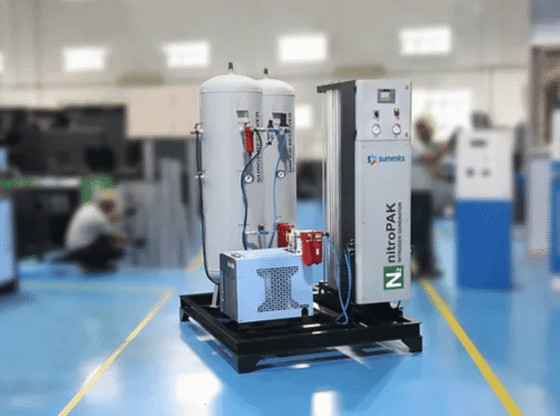
Things look different now. Margins are tighter, production schedules are less forgiving, and any delay in the supply chain tends to create problems that stretch well beyond the department it hits first. For nitrogen-dependent operations, this has prompted a serious rethink. More facilities are moving away from scheduled deliveries and installing generation systems within the building instead. An N2 Generator does exactly that: it produces nitrogen gas on-site, whenever the operation needs it, without waiting on a truck.
What is an On-Site N2 Generator?
Rather than receiving nitrogen in cylinders or bulk storage tanks, a facility generates it directly from compressed air. The system pulls in ambient air, which naturally contains about 78% nitrogen, and separates the nitrogen from oxygen and other gases.
There are two main ways this separation happens in industrial systems:
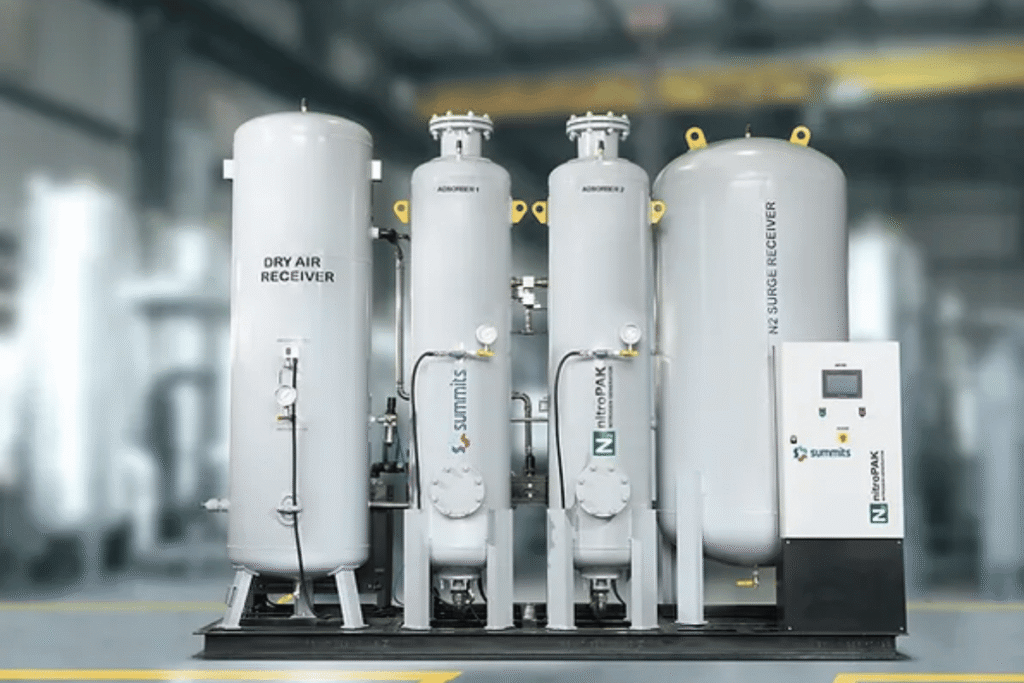
PSA (Pressure Swing Adsorption) uses a carbon molecular sieve, a porous material with very fine, controlled pore sizes. When compressed air passes through it, oxygen molecules are small enough to get trapped inside the pores, while the larger nitrogen molecules pass through as the product gas. PSA systems typically run through two towers, alternating between adsorption and regeneration cycles, allowing continuous output. This method can reach purity levels of up to 99.999%, making it suitable for demanding applications in electronics, pharmaceuticals, and chemical processing.
Membrane separation works differently. Compressed, dried air is pushed through a bundle of hollow polymer fibers. Oxygen, water vapor, and CO2 permeate through the walls of those fibers and are vented off, while nitrogen which passes through more slowly, is collected at the outlet end. Membrane systems are generally simpler and more compact, making them well-suited for applications that need moderate purity levels without the complexity of dual-tower switching.
Once installed, either type of system runs continuously according to demand. There’s no inventory to track, no delivery window to wait for, and no cylinder to change out mid-shift.
Why Facilities Are Moving Away From Cylinders
The cylinder model isn’t broken, but for facilities running demanding production schedules, it creates friction that accumulates over time.
Deliveries don’t always arrive on the day they’re needed. Cylinder rental fees and refill charges recur indefinitely. Storage requires dedicated floor space, internal logistics, and safety management. Every time supply levels drop, someone has to coordinate the next order with an external vendor, time that could be spent elsewhere.
An on-site generator replaces most of that with a single internally managed system. Nitrogen production becomes part of the facility’s own infrastructure, not something dependent on a third party’s schedule.
The Cost Difference Over Time
This is usually where facilities start paying closer attention. Delivered nitrogen comes with layered costs: the gas itself, the cylinders, the delivery, and the recurring coordination overhead. None of those costs disappear on their own over time; most of them increase.
On-site generation shifts the cost structure. The upfront investment is real, but the running costs power, filter replacements, and routine servicing are substantially more predictable than recurring delivery charges. Many operations find that the system pays for itself within a few years, after which they’re producing nitrogen at a fraction of the cost of the external supply.
Where Nitrogen Actually Shows Up in Production
Nitrogen isn’t a niche material. It is central to the daily process in most industries that use it. Food packaging lines use it to displace oxygen and extend shelf life. Laser cutting operations use it as an assist gas to improve cut quality and prevent oxidation at the cutting edge. Pharmaceutical manufacturing relies on nitrogen to create controlled, inert atmospheres. Electronics production uses it to prevent oxidation during soldering and assembly. Industrial processing systems use it for blanketing, purging, and pressure transfer.
In all of these settings, a supply disruption doesn’t just cause inconvenience; it can halt the line entirely. That’s why the reliability angle tends to drive the conversation more than cost savings alone.
Purity Requirements Vary
Not every application needs the same grade of nitrogen. A food packaging line might operate comfortably at 97-99% purity, while electronics manufacturing or analytical processes might demand 99.99% or higher. Membrane systems are generally preferred for lower-to-moderate purity applications due to their simplicity, while PSA systems are the standard choice for very high purity applications.
One practical advantage of on-site generation is that purity can be configured during installation to match the process’s actual needs, rather than accepting whatever grade comes in the cylinder. That’s particularly useful for facilities that run different processes on the same site.
Less Handling, Fewer Logistics Headaches
Cylinders need proper storage areas with ventilation, security, and dedicated handling equipment. They need to be moved around the facility, tracked, and returned to the supplier when empty. In a busy production environment, all of that movement creates its own category of risk and operational overhead.
An installed generator eliminates most of that. Nitrogen comes out of a fixed pipeline. There’s no cylinder swapping, no internal transport, and no inventory count at the end of the shift. For facilities that have been dealing with that cycle for years, the difference is noticeable quickly.
Maintenance Is More Manageable Than Many Expect
One concern that comes up regularly is the need for servicing. The assumption is that generating nitrogen internally requires complex equipment. In practice, modern industrial N2 generators are built for sustained use with straightforward maintenance schedules, periodic filter replacements, compressor checks, and performance monitoring. For most facilities, that’s less demanding than managing cylinder inventory and deliveries on an ongoing basis.
Choosing the Right System Still Takes Careful Planning
The shift to on-site generation works best when the system is matched properly to actual operational conditions. Facilities typically evaluate several factors before selecting a setup:
- Purity level determined by the specific production process, not a generic estimate
- Flow capacity matched to peak demand, not average consumption
- Operating schedule continuous operations require differently sized systems than shift-based ones
- Available installation space membrane systems have a smaller footprint; PSA setups need more room
- Power availability running costs depend partly on the compressed air supply feeding the unit
Getting the specification wrong usually means either under-delivering on nitrogen supply during peak demand or oversizing a system that adds unnecessary cost. Neither outcome is ideal, which is why matching the generator to real site conditions matters more than selecting based solely on capacity figures.
Nitrogen Is Now Treated as Core Infrastructure
The clearest sign of how this has changed is in how facility managers talk about nitrogen. A few years ago, it was a consumable. Today, for most industries that rely heavily on it, it sits alongside compressed air and power as part of essential production infrastructure. That shift in thinking is one reason on-site generation has grown from a niche option into a standard consideration for new facility builds and equipment upgrades.
Kanoo Machinery is a leading solutions provider across the UAE, supplying industrial equipment to sectors including manufacturing, oil and gas, petrochemicals, fabrication, food processing, and pharmaceuticals. Our portfolio includes nitrogen generators alongside compressed air solutions, construction equipment, materials handling, mobile cranes, welding equipment, and more. Kanoo Machinery maintains spare parts counters and service support across eight locations. Get in touch with us at 800-KM100(56100).
FAQs
What is an N2 Generator used for?
It produces nitrogen gas on-site for use in industrial and manufacturing processes, including food packaging, laser cutting, electronics assembly, pharmaceutical production, and chemical processing.
How does an on-site nitrogen generator work?
It separates nitrogen from compressed air using either PSA (Pressure Swing Adsorption) technology, which traps oxygen in a carbon molecular sieve, or membrane separation, which uses hollow polymer fibers to allow oxygen to permeate away while nitrogen is collected.
Why are companies reducing cylinder usage?
Cylinders involve recurring costs, delivery dependencies, storage demands, and handling requirements. On-site generation removes most of that and gives facilities direct control over their nitrogen supply.
Can nitrogen purity be adjusted?
Yes. Both PSA and membrane systems can be configured to meet specific purity requirements based on the application. PSA systems can achieve up to 99.999% purity; membrane systems are typically used for moderate-purity needs.
Is an N2 Generator suitable for continuous operations?
Yes, both PSA and membrane systems are designed for sustained industrial use, making them well-suited to facilities running long or uninterrupted production shifts.