




















Nitrogen is not a speciality gas in the UAE’s industry; it’s a daily operational requirement across food packaging lines. For most of these operations, nitrogen has traditionally arrived in cylinders or bulk liquid tanks on a delivery schedule managed by an external supplier.
That model works until it doesn’t: a delayed delivery during a production run, rising transport costs, storage space consumed by cylinder management, and the recurring coordination overhead of managing an external gas supply.
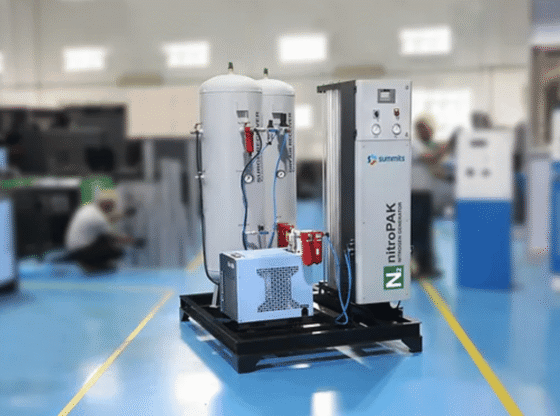
The nitrogen generator changes that equation by producing nitrogen on-site, continuously, from compressed air. More UAE facilities are making that switch not because the technology is new, but because the operational and financial case for it has become increasingly clear.
How a Nitrogen Generator Actually Works
Atmospheric air is approximately 78% nitrogen. A nitrogen generator separates that nitrogen from oxygen, water vapour, and other trace gases using one of two technologies Pressure Swing Adsorption (PSA) or membrane separation and delivers it at the purity and flow rate the application requires.
PSA (Pressure Swing Adsorption)
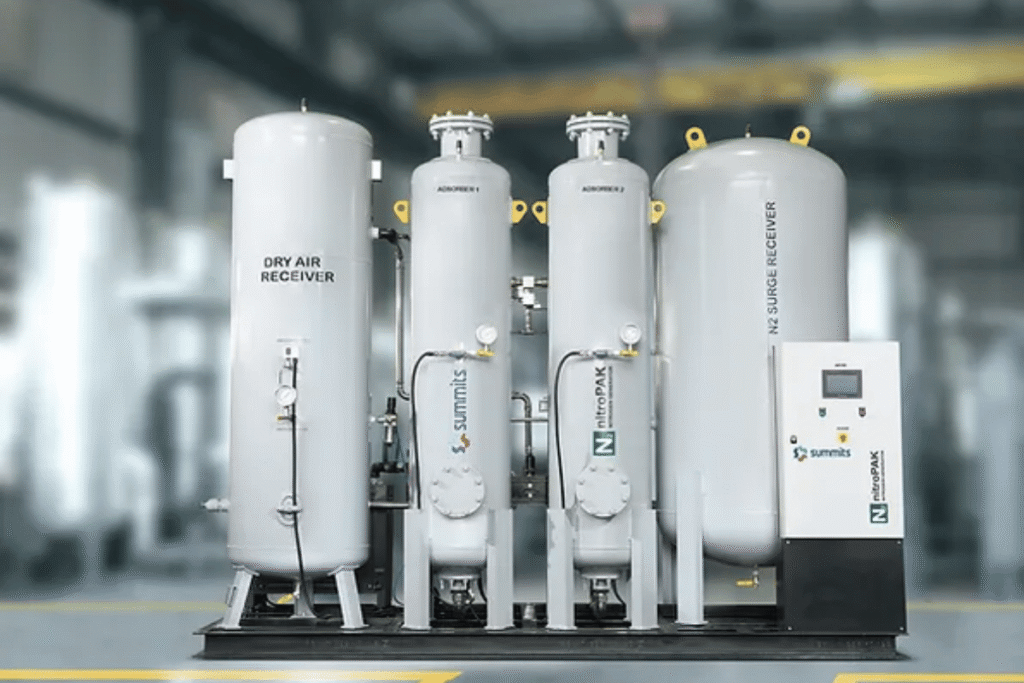
Compressed air passes through a vessel filled with Carbon Molecular Sieve (CMS) a material with precisely controlled pore sizes that adsorb oxygen molecules while nitrogen passes through. PSA systems use two vessels alternating between adsorption and regeneration cycles, allowing continuous nitrogen output. Purity is adjustable from 95% to 99.999%, making PSA the correct technology for applications requiring high-purity nitrogen pharmaceutical manufacturing, electronics production, analytical laboratory use, and heat treatment processes.
Membrane Separation
Compressed, dried air is pushed through a bundle of hollow polymer fibres. Oxygen and water vapour permeate through the fibre walls and are vented; nitrogen which passes through more slowly is collected at the outlet. Membrane systems are compact and mechanically simple, with no moving parts in the separation module. They deliver purity levels between 95% and 99.5%, which suits the majority of food packaging, laser cutting, inerting, and purging applications. Above 99% purity requirements, PSA becomes significantly more cost-efficient than membrane.
Both systems are paired with a nitrogen generator compressor the compressed air source that feeds the separation process and a buffer vessel that smooths output pressure and accommodates demand fluctuations.
Why UAE Facilities Are Moving Away From Cylinder and Bulk Supply?
Delivery dependency creates operational risk
A production line that depends on nitrogen cylinder deliveries is dependent on a third party’s logistics schedule, fleet availability, and fuel costs. In the UAE, where facilities in Jebel Ali, KIZAD, and Sharjah’s industrial zones run continuous shifts, a delayed delivery doesn’t just create inconvenience it stops production. A nitrogen generator removes that dependency entirely. Nitrogen is produced when the compressor runs, regardless of what’s happening with any supplier’s delivery schedule.
Cylinder handling is operationally inefficient
Cylinders require storage areas, internal transport, safety management, regular stock monitoring, and cylinder return coordination. On a busy manufacturing floor, that overhead is real and accumulates across every shift. A nitrogen generator replaces all of it with a fixed pipeline delivering nitrogen directly to the point of use.
Recurring costs accumulate over time
External nitrogen supply involves cylinder rental fees, refill charges, delivery costs, and the logistics coordination overhead of managing stock levels. None of those costs reduce over time. A nitrogen generator converts nitrogen from a recurring purchase into a utility produced internally the ongoing costs are electricity, compressed air, and periodic maintenance, all of which are substantially more predictable and lower than external supply at sustained volume.
UAE Industries Where On-Site Generation Makes Most Sense
| Industry | Nitrogen Application | Typical Purity Required |
| Food packaging | Atmosphere modification, shelf life extension | 99–99.5% |
| Laser cutting | Assist gas, oxidation prevention at cut edge | 99–99.9% |
| Electronics manufacturing | Oxidation prevention during soldering and assembly | 99.9–99.999% |
| Pharmaceutical production | Inert atmosphere during packaging | 99.5–99.999% |
| Oil and gas | Purging, inerting, pipeline testing | 95–99% |
| Metal fabrication and heat treatment | Controlled atmosphere furnace applications | 99–99.99% |
What to Assess Before Installing a Nitrogen Generator
Getting the specification right upfront avoids the problem of installing a system that under-delivers on purity or flow rate, or one that’s oversized and runs at unnecessary energy cost.
- Required purity Application-specific, not a general estimate. Electronics soldering and pharmaceutical packaging have fundamentally different purity requirements from food packaging or purging applications.
- Peak flow rate The generator must handle peak demand, not average consumption. A system sized to average flow causes purity drop or pressure loss at peak demand.
- Compressed air supply The nitrogen generator compressor requires clean, dry compressed air at adequate pressure and flow. If an existing compressor is being used, its output capacity and dew point need to be assessed against the generator’s inlet specification.
- Installation space PSA systems require more floor space than membrane systems due to the dual-vessel configuration. Membrane systems are compact but may require additional components for higher purity applications.
- Operating hours Systems running multiple shifts accumulate hours faster than shift-based operations. Filter replacement intervals and service scheduling should reflect actual operating hours, not calendar time.
Final Take
The case for on-site nitrogen generation in the UAE facilities comes down to control and cost. A nitrogen generator removes dependency on delivery schedules, eliminates cylinder handling overhead, and converts a recurring external supply cost into a predictable internal utility. The technology PSA or membrane, matched to the actual purity and flow requirement is well-established and mature. Getting the specification right, matching the compressor supply correctly, and maintaining the system on schedule are what determine whether the generator delivers the return the switch was made for. For UAE facilities evaluating nitrogen generators across manufacturing, food, pharmaceutical, electronics, and industrial applications, Kanoo Machinery provides equipment supply, specification guidance, and full after-sales support. Contact our team at 800-KM100(56100).
FAQs
What is the difference between a PSA and membrane nitrogen generator?
PSA systems use Carbon Molecular Sieve to deliver purity from 95% to 99.999% suited to high-purity applications in pharmaceuticals, electronics, and heat treatment. Membrane systems use hollow polymer fibres and deliver 95% to 99.5% purity suited to food packaging, laser cutting, purging, and inerting. Above 99% purity, PSA is significantly more energy-efficient than membrane.
How is the nitrogen generator compressor sized for a UAE facility?
The compressor must deliver clean, dry compressed air at the pressure and flow rate the generator’s inlet specification requires at peak demand. Existing compressor output, dew point, and delivery pressure all need to be assessed before integration with a nitrogen generator.
What ongoing maintenance does a nitrogen generator require?
Periodic filter replacement, compressor servicing, CMS condition monitoring in PSA systems, and routine performance checks. Operating hours in UAE multi-shift environments compress maintenance intervals relative to calendar-based schedules.
What purity level does laser cutting in the UAE typically require?
Laser cutting applications typically require 99% to 99.9% nitrogen purity, where nitrogen acts as the assist gas to prevent oxidation at the cut edge and improve cut quality on stainless steel and aluminium. Membrane systems cover most laser cutting requirements.