



















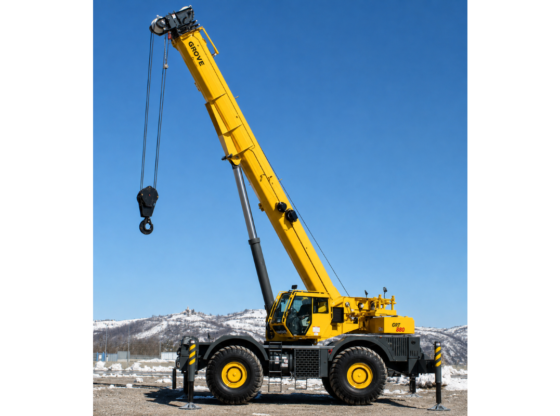

Choosing crane capacity for a site is not just a matter of picking the highest tonnage available. Site access, load radius, boom reach, and ground conditions all affect which unit is the right fit. This post walks through the specs that matter when selecting a Grove rough terrain crane from Kanoo Machinery KSA and defines two current models, the GRT655L and the GRT880, to show how those specs translate into real site decisions.
Why Rated Capacity Isn’t the Whole Picture
A crane’s maximum capacity, usually listed as a headline tonnage figure, only applies under specific conditions: full outrigger extension, a defined load radius, and the boom in a set configuration. On a real site, capacity drops as boom length increases or load radius extends, so matching a crane to a job means looking past the headline number and checking the load chart at the boom length and radius the job requires. The GRT880’s headline 80t rating, for example, only holds at a specific radius and boom configuration; extend the boom further or move the load out, and the safe working load on its chart drops well below that figure.
Rough Terrain Cranes Within the Mobile Telescopic Crane Category
Rough terrain units are a category of mobile telescopic cranes, built specifically for off-road manoeuvrability rather than public road travel. Compared with truck-mounted or 1, which are built to self-drive between sites on public roads, a rough terrain unit is built to work on compact, uneven ground close to the point of lift, with four-wheel drive and large tyres suited to construction sites, plant yards, and rig locations. That distinction matters when choosing capacity too, since a rough terrain crane’s working envelope is shaped as much by the site it needs to access as by the tonnage it needs to lift. The GRT655L is a good example: built for off-road access rather than road travel, it suits plant yards and rig sites a road-going crane could not reach.
Key Specs Worth Comparing
A few figures on a spec sheet matter more than the headline capacity number when matching a crane to a site:
- Main boom range: sets the minimum and maximum reach without an added jib, and determines how close or far the crane can sit from the lift point (10.8 m to 43.0 m on the GRT655L, for example).
- Jib or extension: adds reach for taller or more offset lifts once the main boom is at full length.
- Max tip height: the practical ceiling for a lift, which matters more than capacity alone on sites with height-restricted lifts (68.0 m on the GRT880).
- Engine output: affects how the crane performs under load and how quickly it can reposition between lifts.
- Gross vehicle weight: influences ground bearing pressure and which sites the crane can access without additional matting.
Grove GRT655L vs. Grove GRT880: A Side-by-Side Look
The GRT655L and GRT880 referenced above are two Grove rough terrain crane models. The table below lays out the full side-by-side specs.
| Specification | Grove GRT655L | Grove GRT880 |
| Max Capacity | 50 t (Nominal)/51 t | 80 t |
| Main Boom | 10.8 m – 43.0 m | 12.6 m – 41.1 m |
| Boom Type | 5-section, full power | 4-section, full power |
| Jib/Extension | 7.9 m – 13.7 m telescopic offsettable | 10.1 m – 17.1 m bi-fold swingaway |
| Max Tip Height | 59.7 m | 68.0 m |
| Engine Output | Cummins QSB6.7L (122 kW) | Cummins QSB6.7L (194 kW/205 kW) |
| Gross Vehicle Weight | 34,555 kg | 52,525 kg |
The GRT655L’s five-section boom gives it a best-in-class boom length for its capacity class, which suits plant and maintenance work and rig move applications where reach matters more than outright tonnage. The GRT880 trades boom sections for a higher capacity and taller tip height, better suited to heavier lifts and taller structures.
Features That Affect the Right Choice Beyond Tonnage
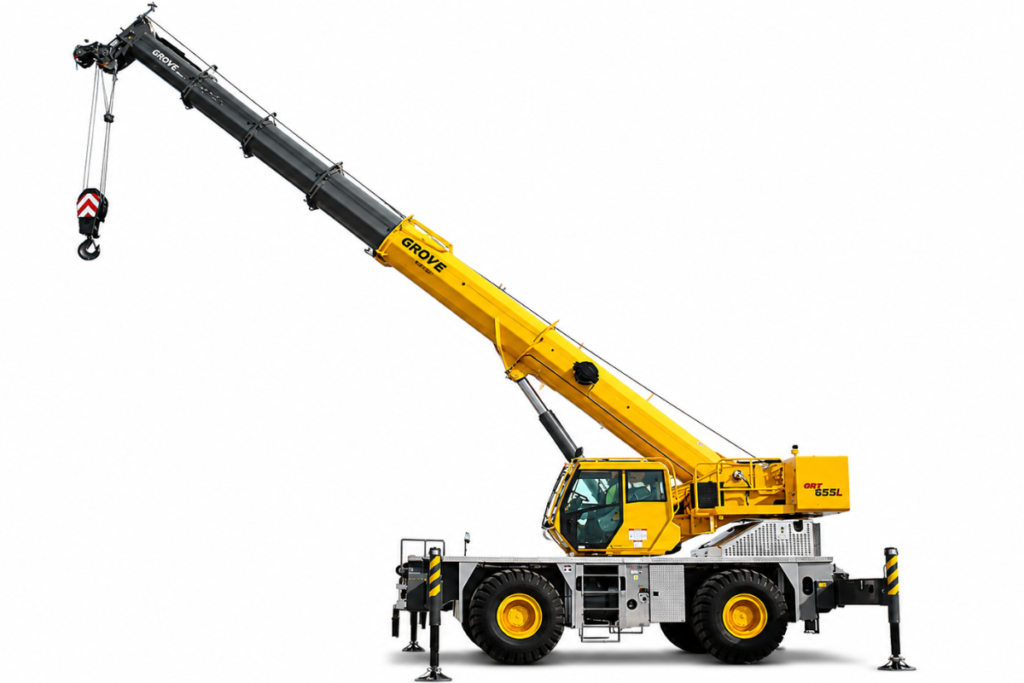
A few design features affect how well a crane performs once it’s actually set up on site:
- Multiple steering modes make manoeuvring in tight yards or congested sites easier than a single fixed setup.
- Inverted outrigger jacks protect the cylinder rod and seal from dirt, sand, and impact damage (crucial in desert/rig environments).
- Smart sensor outrigger extension cylinders deliver more accurate and repeatable outrigger lengths than older string pot sensors, which matters when a site is graded unevenly.
- Grove’s patented CCS crane control system gives the operator real-time load chart and rated capacity information throughout the lift.
These features are part of why a Grove rough terrain crane is commonly specified for rig move applications and plant or maintenance work, where site conditions tend to be tighter and less predictable than a typical open construction site. Kanoo Machinery KSA supplies both the GRT655L and GRT880 across Saudi Arabia, with service support to match.
Conclusion
Capacity is the starting point, not the whole answer. Boom length, tip height, ground bearing, and set-up features all determine whether a crane actually works for a given site. Comparing models like the GRT655L and GRT880 side by side, and checking how the load chart holds up at the actual boom length and radius a job requires, is the most reliable way to choose the right crane for a site. Kanoo Machinery KSA’s crane team can walk through load charts for a specific job to confirm the right fit.
FAQs
What’s the difference between a rough terrain crane and All Terrain and Truck Cranes?
Rough terrain cranes are built for off-road manoeuvrability close to the lift point, while other mobile telescopic cranes, such as truck-mounted or all-terrain models, are built to self-drive between sites on public roads.
Are Grove rough terrain cranes suited to rig move work?
Yes. Rig move applications are one of the primary uses for this crane category, particularly models like the GRT655L, which combine a longer main boom with the manoeuvrability rough terrain units are built for.